
About RCC · RCC Documentation
Why RCC is a game changer
For policy makers, research leaders, and institutional decision makers
RCC turns research computing from a sequence of bespoke local solutions into reusable institutional infrastructure: governed locally, shared across disciplines, automatable, auditable, and designed to keep valuable research capacity available over time.
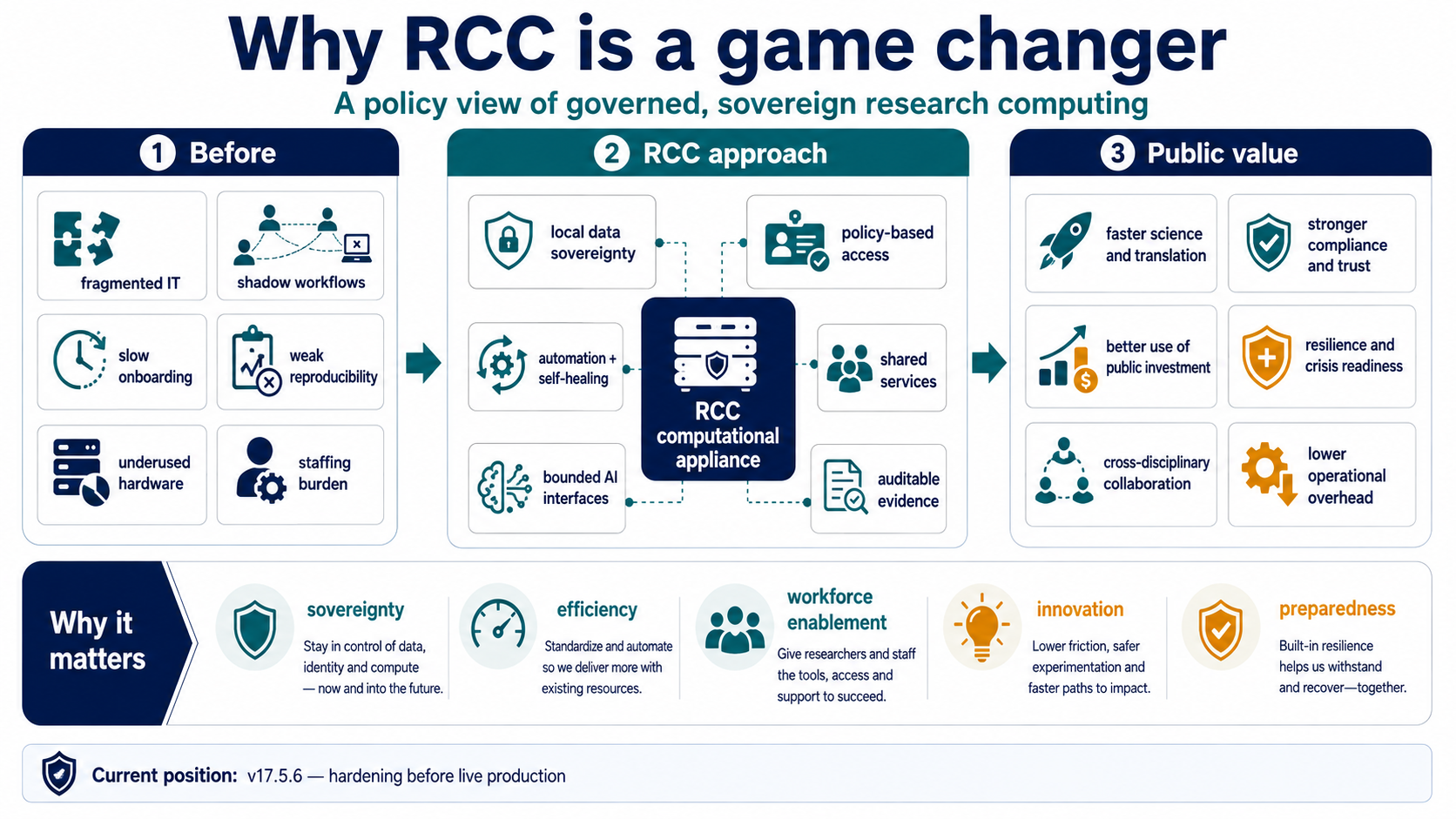
The policy change is organizational as much as technical: common infrastructure lets institutions invest once in capabilities that many projects can use safely.
Sovereignty
Keep institutional control of data and compute
RCC provides a local policy boundary for sensitive data, research identity, compute, and services while still supporting modern workflows and bounded external integration where appropriate.
Efficiency
Reuse infrastructure instead of rebuilding it
Shared identity, project governance, scheduling, storage, transfer, observability, and service runtime reduce duplicated technical work and improve utilization of existing hardware and staff expertise.
Preparedness
Make resilience an institutional property
Automation, evidence, canaries, and recovery mechanisms reduce dependence on individual administrators and provide a stronger base for research continuity and crisis response.
For technical review
The governance claims map to explicit system boundaries
The computer-science architecture view shows where access, policy, execution, data, and operational assurance are separated.