
About RCC · RCC Documentation
Less infrastructure friction, more science
For clinicians, wet-lab researchers, and bioinformaticians
RCC gives a research project one governed place to work with data, analysis tools, CPU and GPU resources, reproducible workflows, and AI-assisted methods without requiring every group to assemble its own computing platform.
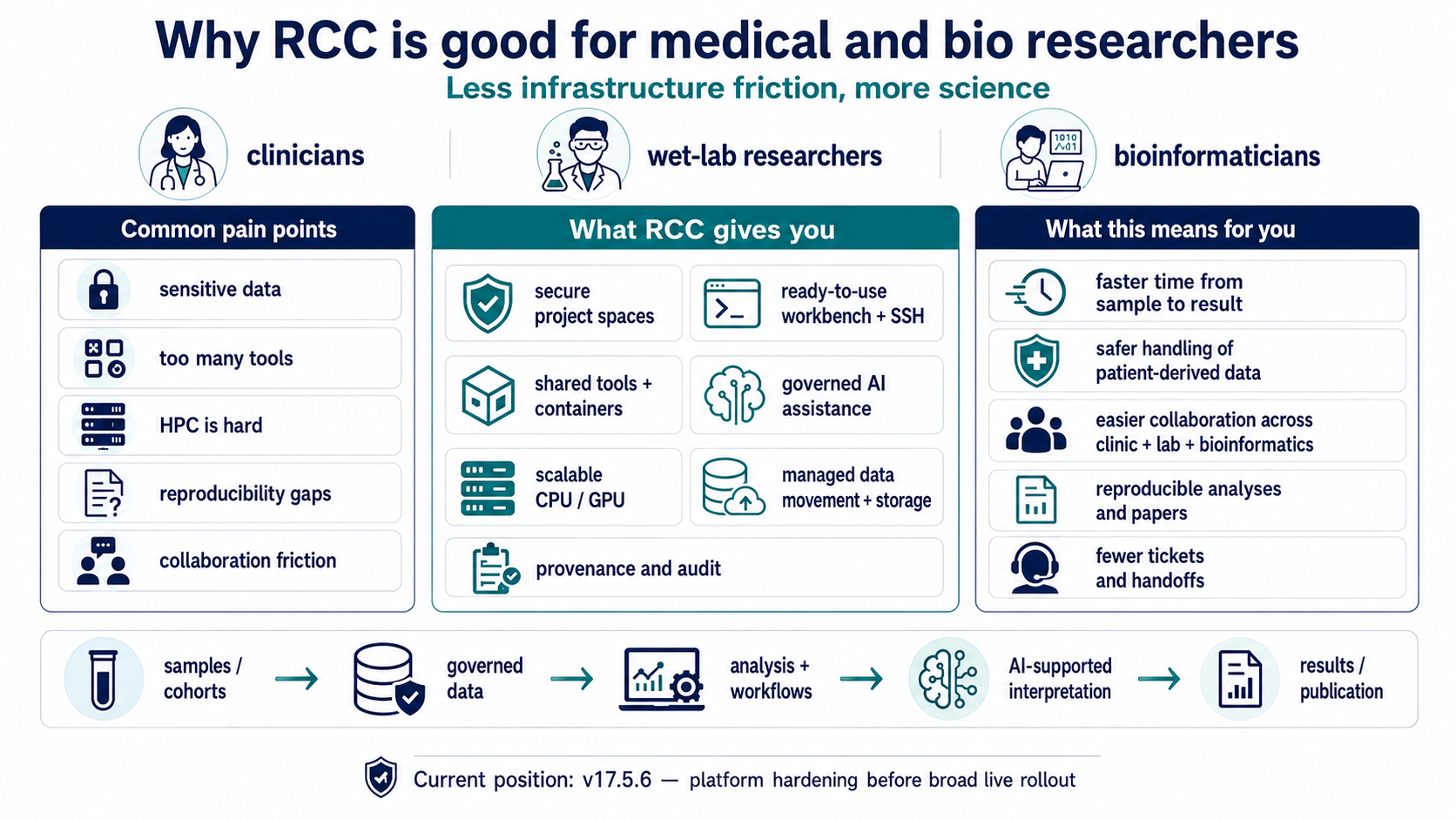
The goal is not to turn biomedical researchers into infrastructure specialists; it is to make secure, scalable, reproducible computing a normal part of the research workflow.
Start with the project
Data, people, and tools stay connected
A project can bring together clinical collaborators, laboratory scientists, and computational researchers while keeping permissions and data ownership explicit.
Scale when needed
From notebook to scheduled CPU or GPU
Interactive exploration and larger analyses use the same project context. You can move from small tests to substantial computation without rebuilding the environment around the science.
Keep the result defensible
Reproducibility and governance travel together
Versioned code, containers, provenance, audit evidence, and managed data movement support reproducible papers while sensitive or patient-derived data remains subject to institutional controls.
Using RCC
Get your RCC identity first, then join projects
My RCC is the single place to request, activate, recover, and manage your account credentials. New accounts belong to one permanent primary group; project membership is added separately after account creation. ClusterDocs covers the practical path from first login to reproducible scheduled analysis.