
About RCC · RCC Documentation
RCC internal structure
For computer scientists and systems researchers
RCC separates access, privileged control, data, compute, and assurance so that the trust boundary of each operation is visible and reviewable.
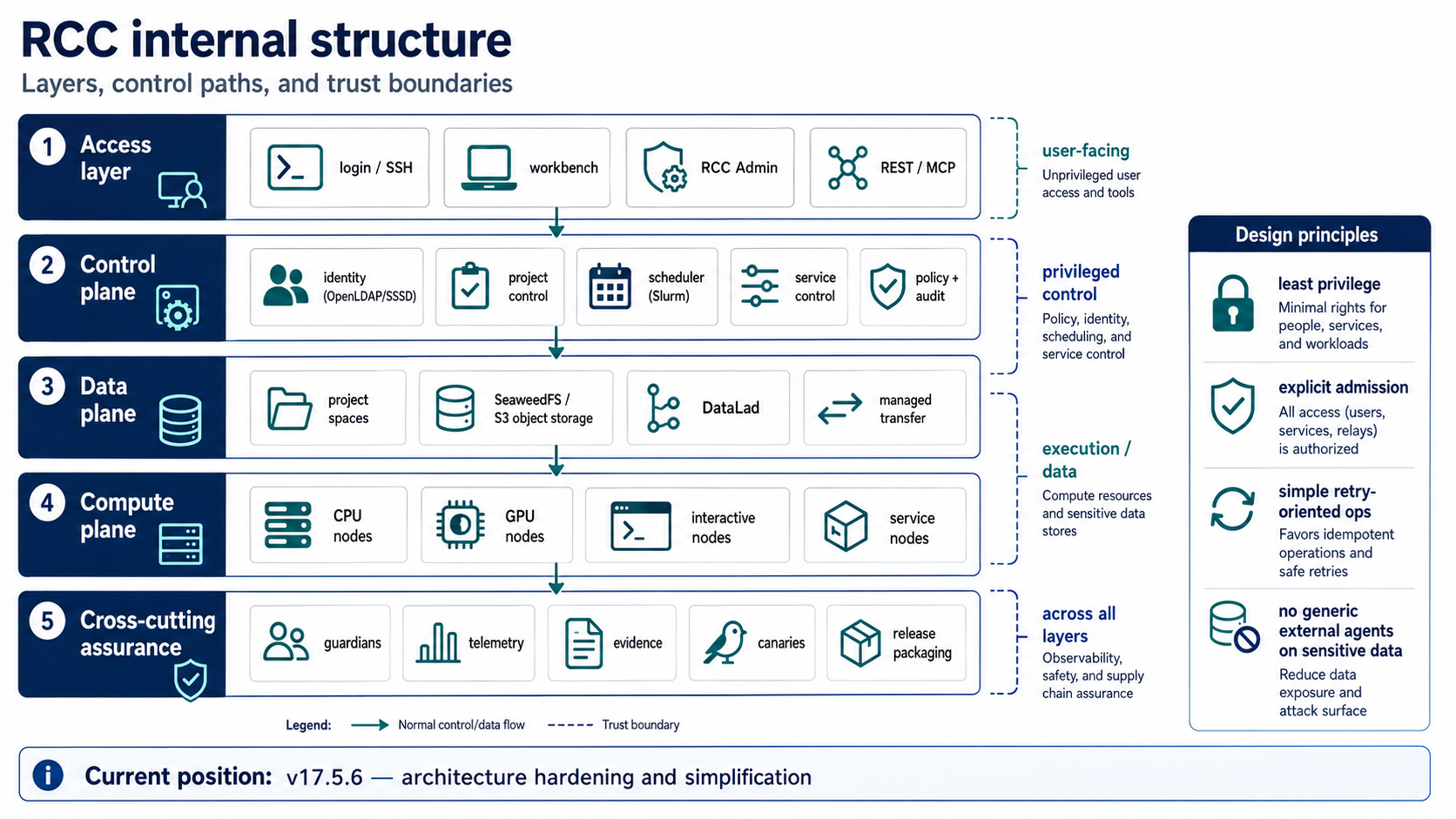
The architecture keeps ordinary user access distinct from privileged control while observability, evidence, canaries, and release assurance span the system.
Control plane
Projects are the durable unit
Identity, membership, service entitlement, scheduler policy, data ownership, and lifecycle state are tied to projects rather than reconstructed independently by every application.
Execution and data
Compute is replaceable; policy is not
CPU, GPU, interactive, and service nodes can evolve independently from project semantics. Object storage, managed transfer, and DataLad remain governed through the same project context.
Assurance
Evidence is part of the architecture
Guardians, telemetry, canaries, and protected release packaging make deployment and recovery claims testable instead of relying on implicit operator knowledge.
Other viewpoints
The same system, explained for its users and institutions
See why this architecture matters to biomedical researchers or to institutional policy and strategy.