
About RCC · RCC Documentation
What RCC is
For computer scientists and systems researchers
RCC is a governed computational appliance for research computing: a structured middle layer between researchers or agents and institutional compute, data, services, identity, policy, and operations.
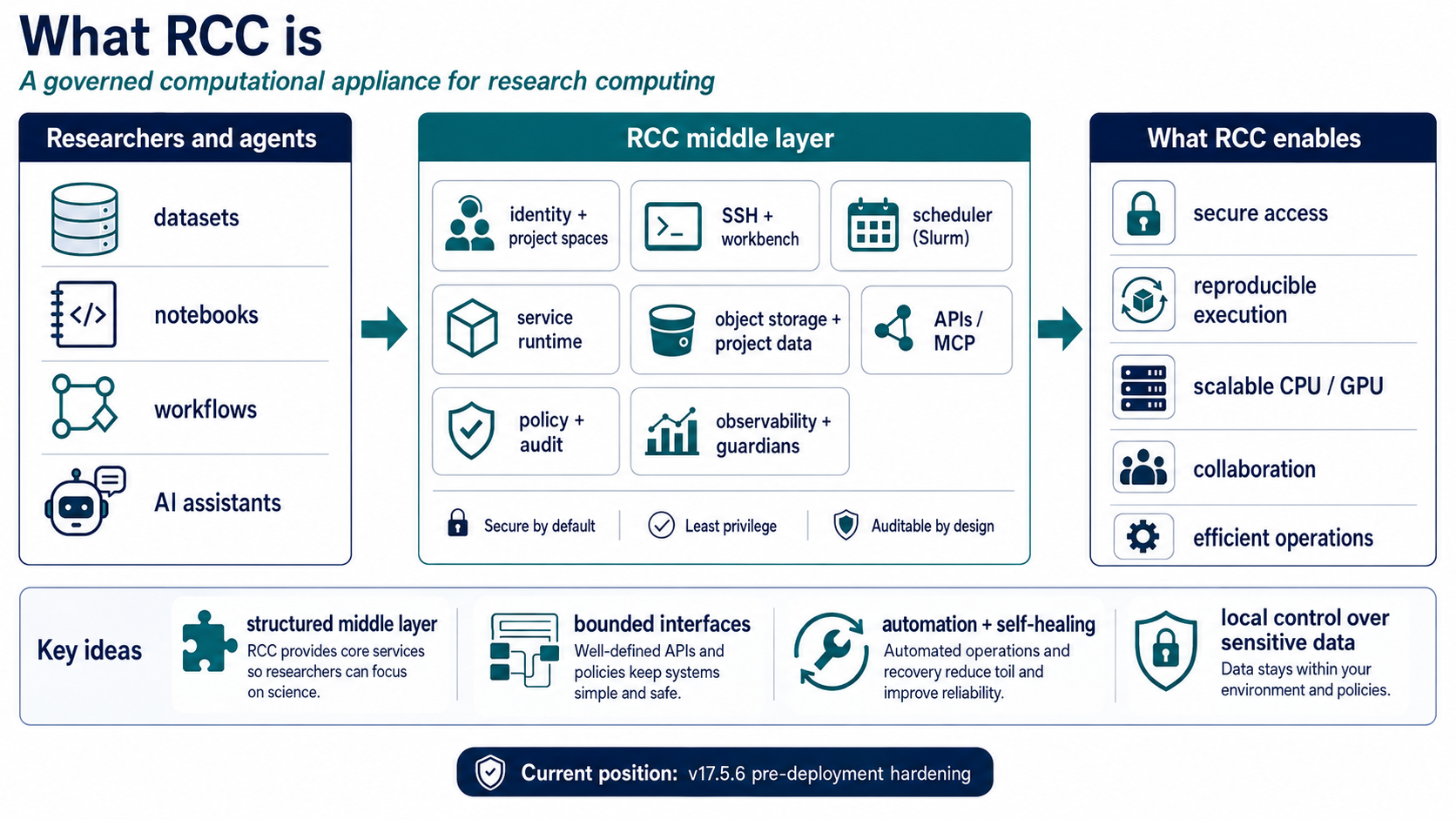
RCC is deliberately more than an HPC scheduler and less than an unrestricted cloud: it makes the institutional rules around research computation explicit and reusable.
System idea
A mediated substrate, not a pile of hosts
Users, applications, and agents request bounded capabilities through project-aware interfaces. Identity, policy, data ownership, scheduling, and provenance remain part of the system rather than application-specific afterthoughts.
Why it is interesting
Make the safe path the easy path
RCC combines conventional cluster mechanisms with explicit admission, auditable control paths, retained evidence, and automated recovery. The research question is how far this structure can reduce operational toil without reducing scientific flexibility.
Agentic computing
Agents operate through capabilities
RCC does not require an AI agent to become a cluster administrator. The same bounded interfaces used by people and software can mediate project context, resource requests, data access, and operations.
Go one level deeper
See the internal architecture and trust boundaries
The architecture view separates user-facing access, privileged control, data, compute, and cross-cutting assurance.